Blogs I Love Math Literature Freebies About Home

Saturday, April 12, 2014

Counting Coins with Second Graders

My second grade group has been working on counting coins and the symbolic notation of money recently.   Here is the Common Core standard for money in grade 2

CCSS.MATH.CONTENT.2.MD.C.8
Solve word problems involving dollar bills, quarters, dimes, nickels, and pennies, using $ and ¢ symbols appropriately. Example: If you have 2 dimes and 3 pennies, how many cents do you have?

Here are some of the activities my students are doing to practice these skills.


Money Bags Board Game

This is a game I purchased several years ago and my students love it!  I show 4-5 kids who are leaders in the classroom how to play it and they in turn teach it to other kids.  I have 4 of these games because each year, I decided I need another one!  This gives me almost enough for everyone to play at the same time which I love.  When I just owned 2 of these, I used them as part of math stations which I still do in addition to the times where most kids in the room are playing.

Here is how the game works.  Students roll the dice which often puts them on a spot where they get money.  They spin the spinner to see which coins they are NOT allowed to use to show that amount.  
This student landed on 12 cents and when she spun the spinner, landed on no nickles.  She had to make 12 cents using anything but nickles.  This is a great time to talk about different ways to make 12 cents and which is most efficient.  
This student had to take his money using no dimes
The other part of this game I love is the bank exchange spaces.  When a student lands on bank exchange, they get to trade in their coins for equivalent amounts.  It is a great way to give them practice with fair trades and counting mixed coins.

Once one player gets to the finish line, everyone counts up their money and the person with the most wins.  I have my students count their money and write their money amount on a nearby white board.  This gives them practice with the symbolic notation of money.

Here are the final totals for the five kids playing the game.  If students at grade 2 use just cents notation, I make them try it again using the dollar sign and decimal point.  This is a great opportunity for them to get comfortable with this new notation.
Getting to $1 seemed to be a big goal for this group so we finished up by figuring out how far away everyone was from $1.00.  I think second graders knowing combinations of 100 is super important and this gave them one more way to practice! 

Number Puzzles

I recently finished making a bunch of number puzzles for first and second grade and one of them is all about coins.  We have been using this during math center time and it has been a great way for kids to practice.

Students put out all the cards with numbers written on them.  They then take the cards with coins on them, count the coins and find the matching number card.  The puzzles are self checking because if kids get it wrong, they won't fit together!
A pair of students works to finish up their coin puzzles

Also included with the number puzzles is follow up formative assessment that I used to asses students' current understanding of counting coins.
Two students show what they know about counting coins
Want to try these with your students?  You can grab these coin puzzles for FREE by heading to this page and clicking on preview.  The preview file is free to download and includes everything you need to make the coin puzzles for your students as well as the follow up formative assessment.

If you love the idea of doing number puzzles with your students, you might want decide to purchase the full set which includes number puzzles for Canadian coins, addition facts, subtraction facts, telling time, recognizing numbers to 1000, matching numerals to base 10 pieces, adding double digit numbers, finding 10 more and 10 less and using arrays.  In all there are 11 number puzzles with follow up assessments and they will be 20% off for the next week!

The full set is over 60 pages for one low price!  Save an additional 20% when you purchase it today!
How do you work on counting money with your students?  Please respond in the comments below!


Working on Equality

If you have spent any time teaching math to young kids or have spent any time in a middle school setting, you are probably familiar with the idea that kids really do not know what the equals sign means.  Many students see it as operational meaning here comes the answer.  It is so important for kids to be exposed to ideas of the equals sign meaning equality from a young age.  I have written before about how I have worked on equality here and here if you are looking for ideas to get started.  Today, I want to share with you a recent experience with first graders.

We were working on this Common Core Standard
CCSS.MATH.CONTENT.1.OA.D.7
Understand the meaning of the equal sign, and determine if equations involving addition and subtraction are true or false. For example, which of the following equations are true and which are false? 6 = 6, 7 = 8 - 1, 5 + 2 = 2 + 5, 4 + 1 = 5 + 2.

Understanding this standard directly supports this one and the development of good solid strategies for addition and subtraction facts.

CCSS.MATH.CONTENT.1.OA.C.6
Add and subtract within 20, demonstrating fluency for addition and subtraction within 10. Use strategies such as counting on; making ten (e.g., 8 + 6 = 8 + 2 + 4 = 10 + 4 = 14); decomposing a number leading to a ten (e.g., 13 - 4 = 13 - 3 - 1 = 10 - 1 = 9); using the relationship between addition and subtraction (e.g., knowing that 8 + 4 = 12, one knows 12 - 8 = 4); and creating equivalent but easier or known sums (e.g., adding 6 + 7 by creating the known equivalent 6 + 6 + 1 = 12 + 1 = 13).

I get out my trusty math balance for this activity and start by having kids make some equations that are true.  We then jump into making other equations, recording them on the board and deciding if they are true or false.  I then ask kids to come up with a true equation or come up with a false equation and we test their idea together.  As you can imagine, kids love making up equations that are false.

Here is the start of our equation list.  Students write them on the white board and record T for true or F for false.  
Look at all the different types of equations kids have come up with!
We use the math balance to check out ideas and verify if equations are true or false.
After we have done this whole group activity, it is time for partner work.  I used my Frog and Flower Equality cards to differentiate this partner work for kids.  These cards are offered at 4 different levels so I can make it easier or harder for kids depending on their own levels.  I can also offer kids who are ready more of a challenge or a second set to do when they are ready for it.

Students read the equations and sort them into true or false!

How do you work on equality with your students?  


Friday, April 11, 2014

Subtracting Multiples of 10

My first graders have been hard at work this week working on this Common Core Standard

CCSS.MATH.CONTENT.1.NBT.C.6
Subtract multiples of 10 in the range 10-90 from multiples of 10 in the range 10-90 (positive or zero differences), using concrete models or drawings and strategies based on place value, properties of operations, and/or the relationship between addition and subtraction; relate the strategy to a written method and explain the reasoning used.

When working on this idea of subtracting multiples of 10, I am always struck by how easy it is for some kids and how much other kids struggle with this concept.  Many of my students see doing a problem like 90 -50 as a natural extension of doing a problem like 9 - 5, but others need more support.  Here are some ways we address this standard.

I start out at a very concrete stage by using my magnetic base 10 pieces on the board and having kids solve a few problems as a class.  This usually takes place as a quick warm up and it gets kids thinking about the big ideas behind the concept.  I might start with a problem like 70 - 20 and put 70 up on the board with base 10 pieces.  I then might ask a few kids for an answer and some explanation about how they knew the answer.  It is a great time to start making connections for kids who are not making them for themselves about how 70 - 20 is like 7 tens - 2 tens and is like 7 - 2.

I also do a whole group lesson where each kid has access to unifix cubes that have been snapped into groups of ten.  We do more problems whole group and the kids use the concrete model of the unifix cubes to act out the problems.  This helps more kids see the connection between the fact level problem and the idea of subtracting groups of 10.
A student uses unifix cubes to show 90 - 40

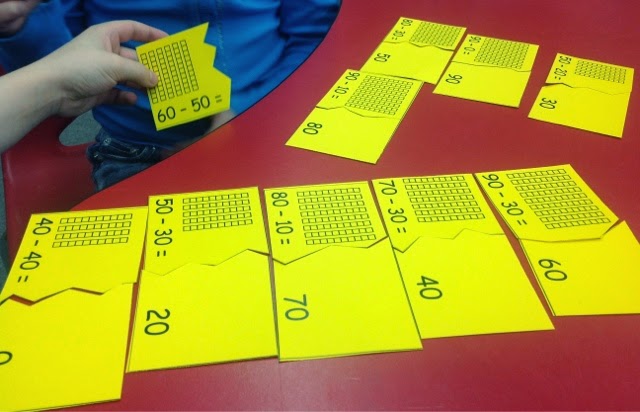
After this, I introduce a game that will be played during math stations the following week.  It is a math puzzle game and is super engaging to students.  I also really like how it has a visual model so support kids who still need it.  As they play it throughout the week, I notice less and less students needing the visual model, but at the beginning of the week, many kids use it.

A student uses her hand to check her answer to 80 - 30.  The puzzles are self-checking!  If a student gets the wrong answer, the puzzle will not fit together.  
A pair of students finishes up the subtracting multiples of 10 puzzles.  
After 4 days of having this included in math stations, I gave the quick formative assessment that comes with the puzzles.
This formative assessment is a great way to asses students current understanding and see who needs more instruction or intervention.  It is part of the grade 1 number puzzle bundle
Based on the results of this formative assessment, I had 3 kids who needed more instruction.  I borrowed an idea from my blogging buddy Linda over at Primary Inspiration and used legos to represent base 10 pieces.  While the other kids were busy with math stations, I pulled these three kids to the back table and we worked on more problems and explicitly tried to make the connection between what they already knew and what they were learning now.


I will check in with these 3 kids again next week but I think they got it now!

How do you address subtracting multiples of 10 with your students?  Please respond in the comments below!


Thursday, April 10, 2014

My Favorite Apps: Quick Math +

In the past I have written about some of my favorite apps including the King of Mathmath slide, line 'em up, the number rack, ten frame fill and the subitize tree.  Today I want to show you another of my favorite apps.

This one is called Quick Math + and it currently costs $1.99.  The single best thing about it is that it is completely easy to adjust for different abilities.  It has 4 basic "games" and each game can be played on 4 different levels.  This means I have been able to use this with students from grade 1 up to grade 5.

Here are the 4 different "games" you can choose from
Each game is offered at 4 different levels

The next best thing about it (and my students' very favorite thing) has been that they get to write the answers directly on the iPad screen using their finger.

A student writes the answer to the problem on the screen with their finger.  It does not matter how big or where on the screen it gets written!  This basically takes a routine practice worksheet and makes it seem like a game to kids.  
My students also like that they get a graph of their results and it shows how fast they completed a level.


For students who really like to move quickly through problems, the next problem is shown at the bottom of the screen so that they can be ready for it.  This is also a great feature if you have students sharing and iPad and taking turns.  One student can be thinking while the other is answering.
Here are a few more screen shots to give you an idea of how much the difficulty can change based on what level you choose.


What apps are you using with students?  Please leave a comment below and include a link to a blog post if you have one!


Tuesday, April 8, 2014

QR Code Scavenger Hunt: Fluency with Multiplication Facts

Spring has finally sprung here and the reality of the end of the school year is getting closer and closer.  With that in mind, I have been noticing that my third graders are still lacking fluency with their multiplication facts.  These facts are something we have worked on in grade 3 for many years but now that we are using the Common Core standards, it is very clear that they should be fluent in this range.  I also have some fourth graders who are not quite there with fact fluency so I created this QR code scavenger hunt another way to give kids more practice.

Here is the Common Core standard for grade 3
CCSS.MATH.CONTENT.3.OA.C.7
Fluently multiply and divide within 100, using strategies such as the relationship between multiplication and division (e.g., knowing that 8 × 5 = 40, one knows 40 ÷ 5 = 8) or properties of operations. By the end of Grade 3, know from memory all products of two one-digit numbers.

This was a lot of fun and I have decided to leave it up in the classroom for students to do again when they are done with other work or have a few minutes of free time.

Here is a peak at the scavenger hunt.  You can grab it for FREE at my TPT Store!  While you are there make sure you are following me so you are the first to know when I post new freebies!

QR code scavenger hunts are a great way to practice routine skills and are much more engaging and fun than worksheets.  They are great for skills like multi-digit addition and subtraction, and double digit multiplication.

If you have never tried a QR code scavenger hunt, check out this post to see how easy it is!

Here are few shots of this freebie in action!


Hope you enjoy this freebie!

Monday, April 7, 2014

Monday Math Literature Volume 38

If you missed last week's post about using Tiger Math: Learning to Graph from a Baby Tigerto help kids learn about similarities and differences between bar and circle graphs, you will want to check it out here!  It has been a very popular post!

This week, I want to share with you a great book for talking about counting, addition, multiplication and equality.  I recently used this book with my third graders to get at the idea of equivalency but have also used it with younger students who have been learning about counting and how to stay organized when counting.


This is a Marilyn Burns Brainy Day Book so it also has a list of suggested activities at the back.  These books also tend to go in and out of print but the used market is quite consistent and the quality is usually great.

In this book the king decides he needs to count all the commissioners he has doing various jobs. He decides that he will have them walk through the room single file and he will count them one by one.  His two royal assistants will also count them.

The counting begins but the king gets interrupted by his daughter and loses track.  He allows his royal assistants to continue counting and they are marking down things as they count.  When they get to the end, one royal assistant reports that he has found there are 23 groups of 2 and one left over.  The king does not accept this answer.  The other royal assistant reports that he found 9 groups of 5 with two left over.  The king also does not like this answer.

He decides to let his daughter try to figure it out and she is able to get the commissioners to stand in groups of 10.  There are 4 groups of 10 with 7 left over.  She quickly shows the kings how easy it is for her to see that is 47 by counting by tens and ones.

I love using this book for kids learning to count collections because of the way the daughter arranges the commissioners into groups of 10.  This story seems to really resonate with young children especially since it is the young girl who figures out the easiest way to explain it to her father.

Here are a few pictures from when I used this story recently with third graders.  The focus this time is on equality.

We started by recording equations on the board that represented each person's answer using multiplication and addition.

Here are the different ways the royal assistants and the princess counted the commissioners.  

We worked together to solve the equations and saw that we ended up with 47 = 47 = 47.  This was a great way to kick of a series of lessons on multiplication facts, equality and what to do when there is more than one operation.  We then followed this up with my spring themed equality cards level 4 (on sale right now for $2!).


Sunday, April 6, 2014

Addition and Subtraction Word Problems and the Common Core

If you are a regular reader of my blog, you know that there are 12 problem types for addition and subtraction word problems that students should know to show mastery of the Common Core Standards.  (If you are not a regular reader of my blog and want to stay up to date with creative ways to practice math, you may want to follow me on Pinterest, Facebook or by typing in your email on the right hand side of this page!)

My second graders have been hard at work on developing conceptual understanding of double digit addition and subtraction over the last few weeks.  They have been inventing and sharing strategies and working with word problems with all 12 different problem types.

Today I wanted to give them a chance for some extra independent practice with these skills.  I also wanted to get them up and moving around because spring fever is definitely in the air and everyone seems to be feeling a bit wiggly.  It wasn't quite warm enough to do this outside but we managed to get up to they gym for this lesson.  (if it is warm enough to be outside in your region, check out track math!)

We used my newest set of word problem task cards
These were a lot of fun for my students!  You can check then out (including a FREE preview) HERE!

I printed the task cards on card stock, cut them apart and placed them around the perimeter of the gym.  Each kid got a clip board and a record sheet and they were off solving problems.  I love how engaged this makes students.  This is usually a group that requires a great deal of management yet for this assignment, I felt like I was on a vacation.

Students move around the gym with clip boards solving problems.  Students can go in any order they want but there are never allowed to be more than 3 kids working near each card.  I also make sure that students know I do not want to see them near the same person over and over again.  
At this point in the year, I wanted to see how students would do on their own with solving these types of problems.  Other times in the year I do a similar activity with fall and winter themed tasks and sometimes these are done with partners.  This time, I had students work alone and then consult with a partner as they finished up.  We call this having a math talk.

A student's record sheet.  They have circled the answers that they disagreed with their partner on and together they will go back and find these cards and try to come to an agreement on an answer. 
Another students' answer key
Once they have come to an agreement on answers, I do a quick consultation with the answer key.  If they have all the answers correct, I give them a blank task card and ask them to write an additional task that would go with this set.   As kids finish writing their own tasks, I have them switch with other kids and solve their problems on the back of their record sheet.

Here are some problems the students wrote to go with the set.  
Once everyone finishes up and we pick up all the cards, I give them this quick formative assessment to see where kids are in the current thinking and who needs more practice with these problem types and who is ready to move on.  It also gives me a look at what strategies students are using to solve double digit addition and subtraction problems.  

Here is a look at some of the problems I used for formative assessment.  You can see that students are using several different strategies to solve these problems.
My students are in great shape with meeting this standard!  I have a small group that needs a bit more practice but so far so good!

Here is how I tucked these away for next year!  All organized and ready to go.

Everything I need in one folder.  Cards, answer key, record sheets and formative assessment prompts.  Copies made and ready to go!
I glue the title page to the front of the folder and I am all set to use these again next year or to try them out with another group!
Want to try these with your students.  Head to my TPT Store to purchase the full set (on sale now!) or get a free preview set!