Blogs I Love Math Literature Freebies About Home

Saturday, December 7, 2013

A set of 7 Dice to Promote Additive Reasoning in Kids of ALL Ages


I have written before about how I use dice to promote fluency with additive reasoning in students of all ages.  Today I want to tell you about a set of 7 dice that I started using a few years ago and have totally fell in love with.  The only place I have found that sells these dice is NASCO.  They are $3.50 a set and worth every penny.  I purchased 12 sets two years ago and ALREADY have gotten my money's worth out of them.  I literally have used them in every single grade K-6 and even in several workshops with adults.  If you want a set, they are available here. (If you are a dice addict like I am and you type dice into the search engine at NASCO you will be in heaven.  They really have an amazing collection.)

So how do I use these dice in so many grades?  Here are some pictures :)
They come in these little baggies which are the perfect thing to store them in.  I put all of my little baggies into a standard pencil box when they are not in use.  The little baggies make passing out and picking up the dice very simple. 
With K and first grade students I might have them get one of the dice with numbers under 10 and roll it and then build that number on a ten frame.  I also might have them get 2 of the smaller dice and roll and add or roll and subtract.  

As my first and second graders work at building addition fact strategies I like to pull the 3 smallest dice from this bag for them to roll and add.  I find it helps them with things like making 10, counting on and doubles.  

As first grade comes to a close and second grade begins, much of my focus moves towards getting students to think about 2 digit addition.  I want my second graders to fluently add any two double digit numbers without using pencil and paper by the end of the year.  I use these dice to help give my kids the extra practice they need using their invented strategies and work on their fluency with addition.  
I also might add in a smaller die to the larger ones and see what interesting combinations we can come up with.  In the roll featured in this picture, many kids would combine the 14 and 6 to make 20 and then add the two twenties.  

My favorite way to use this set of 7 dice is to have students roll and add all of them.  NO PENCIL/PAPER!  If students have had experiences with inventing strategies, are fluent at making 10 and are given time to explore these ideas, I find that I can use the entire set as early as the last third of second grade.  I often start by rolling a set of dice under the document camera and seeing who can find some friendly numbers.  After we have practice some as a class, I set kids up with a partner and their own bag of dice and let them go for it.  Notice in the picture above how the dice have been grouped to make adding easier.  

Here is another look at a roll.  Notice how friendly making tens, twenties, etc makes the adding.  I often find other teachers who are used to only using a traditional algorithm have a more difficult time with this than students do.  I know I was uncomfortable with this when I first started.  If you are going to use these dice with your students, spend some time with them yourself first.  
Another roll

How would you use these dice in your classroom?


Friday, December 6, 2013

A Must have App for Place Value to 1000

I have written before about some of my favorite apps for primary students on more than one occasion but today I want to share with you my favorite app for working on place value to 1000.

It is called Math Slide.  It is free for a limited number of game and 1.99 for unlimited play.  It can be played by 1-4 players and has 10 different games.

Game 1
     In game 1 they show place value pieces, money pieces or a number line and students have to figure out what number it represents.  If they have that number, they touch it with their finger and slide it into the middle.  Many times more than 1 kid will have the number and the first person who gets the correct number into the middle has their number disappear and they are one step closer to winning.
A look at math slide being played by 4 players
Money pieces from game 1 of Math Slide 1000
A number line with a missing number, part of math slide game 1
Game 2
 Game 2 is very different from game 1.  The rules are the same but the context completely changes.  Now students are presented with a number written in expanded notation and have to slide in the number that is equivalent but written in standard notation.  Take a look:

Math Slide 1000 game 2
Another look at Math Slide 1000 game 2
There are 8 additional games for your students to play that work on skills like writing numbers in different forms, finding 10 more and 10 less and 100 more and 100 less.  I have used this game in grades 2-4 with great success.

If you have a tablet and teach in grades 2-4, you might want to check it out.  If you download the free version, you get unlimited rounds of game 1 and 2 rounds of games 2-9.  My favorite part is that 4 kids can play at once and they stay super engaged the entire time!

One warning:  I did have to make a rule early on that each player gets ONE chance to slide a number in per turn.  Without this rule some kids were just sliding in random numbers as fast as they could without doing any thinking.  If they break this rule, they don't get to play!

If you teach other grades, there are other versions of Math Slide you might want to try out!

Thursday, December 5, 2013

Estimating and Counting Routines Part 5

If you are new to my estimating and counting posts, click here to start at the beginning.  I have explored many ways that I use estimating and counting routines in classrooms grades K-5 to improve a wide variety of math skills.


Today I want to share with you an estimating and counting activity that I did with a group of 5 first graders.

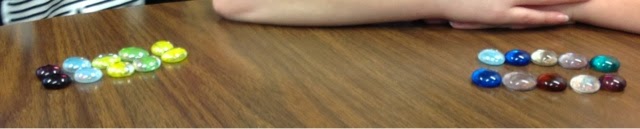
The manipulative of choice today was gemstones.  These are always a big hit with kids!  I bought a multi-colored pack of them years ago and have slowly been adding to the collection over time.  They are colorful and fun and flat so they don't roll off the table!

I started by dumping out the gemstones and pulling 10 to the side.  Based on this, I asked each kid to estimate how many were on the table.  Because we have been practicing reading and writing numbers to 120, I had them each record their estimate on the whiteboard.

Their original estimates are written in the column second from left.  Everyone estimated either 90 or 50.  I did have to enforce the no guessing 100 rule with this crew.  It is a rule I often have to pull out with young kids who estimate 100 whenever they see more than 20.  
Next I asked the students if there were enough gemstones for each kid to have 10.  They all answered yes and I asked each student to take 10 gemstones.

Each kid took 10.  When they were done, I asked them to look around and see if there was a student who I could just look and know there was 10 in their space.  These two students showed different ways to know there was 10.  One student arranged theirs into a 10 frame and the other put theirs into 2 groups of 5.  The other students quickly decided that they too needed to show their gemstones in a way that made it easy to see there were 10. 
After each kid took 10, we counted by 10's and found out that 50 gemstones had been counted.  I had a student write the number 50 and we discussed what the 5 meant.  This is a great way to connect the idea of 5 tens to concrete objects.  I then let each kid go to the board and adjust their estimates based on the information we had so far.
You can see the estimates went up quite a bit.  Some kids needed to ask for help from their peers on how to write a number of this size.  I also noticed that kids were more confident and everyone chose a different number.  
I then asked if there were enough left in the center of the table for us to each take 10 more.  The kids all thought there was and went ahead and took 10 more and again arranged them in a way that it was easy to know there were 10.


We counted by 10's around the circle and found that we had 100 gemstones counted.  We also double checked our counting by counting by 20's around the circle.  The kids had never been asked to do this before but it went very well.  They quickly realized that they could think about counting by 10's to help them with this.  We also discussed the idea that it did not matter who started the counting or what direction we went around the circle, there would still be 100.  One little girl thought we should count by 5's as well (hers were arranged in more distinct groups of 5) we did that which was another great way to practice an important first grade skill.

I then let kids make one last estimate.

You can see that our numbers are getting quite large and technically farther than what is required of first graders.  I find the more kids get exposed to numbers over 100 the better they are in that 100-120 range.  If kids can do the numbers between 100 and 120 than they certainly can do the numbers up to 200.  
I once more asked if there were enough for everyone to take 10.  They agreed there was and each took 10 more.


We again counted by 10's (OVER 100!!!)  

Our pile in the center of the table was getting quite small.  I asked kids if there was enough for everyone to take 10 more and they were sure there were not.  I asked for ideas about how many more they could each take.  After some discussion, we came to an agreement that 5 more would work. 


There were a few left in the center of the table. So we arranged them in a group of 10 as well.  The kids were having a tricky time figuring out how many altogether so we decided to push the groups of 5 into groups of 10.

Here is a final shot of what the table looked like when we were finished.  We counted them all by 10's and then had 1 left over.  
We wrote our final number and were out of time so we did a quick clean up and will continue working on these ideas as the year goes on.

How do you work on counting and estimating in your classroom?

Wednesday, December 4, 2013

Over 200 Winter Freebies!

The folks at Teachers Pay Teachers have gotten together to offer 4 FREE e-books full of over 200 holiday teaching tips and FREE products.


The books are offered at 4 different levels.  Just click on the grade span you are interested in to head to TPT and download your freebies!

Pre-k/ k

Grades 1 and 2

Grades 3-6

Grades 7-12

Enjoy!

Odd and Even Numbers and the Common Core

Knowing about odd and even numbers is one of the big ideas that kids need to develop in grades K-2 that will help them with math concepts as they move through elementary school.  If students understand what odd and even numbers are, they can move on to learning what happens when odd and even numbers are added, subtracted, multiplied and divided.  

Where does the concepts of odd and even show up in the Common Core?

Second grade.  Here is is.

  • CCSS.Math.Content.2.OA.C.3 Determine whether a group of objects (up to 20) has an odd or even number of members, e.g., by pairing objects or counting them by 2s; write an equation to express an even number as a sum of two equal addends
By the end of grade 2, kids should have a solid understanding of the basic concepts of odd and even so they can further develop these ideas as they move through grades 3 and 4 and can start thinking about how they can apply these ideas to help them with arithmetic.  

I have a small group of third grader who I have noticed over the last several weeks seem to be struggling with the idea of odd and even.  They certainly had some basic knowledge but some of it seemed fragmented or missing or they were very unsure.  I found 15 minutes to pull them out of class for a quick booster group to address these big ideas.  I want to share with you how we quickly got at what it means for a number to be odd or even, noticed how it extends to numbers beyond 20, and practiced our new found knowledge.  

I started by writing the numbers 1-10 on the board.  I asked the students if they could tell me any of the numbers written on the board that they knew for sure were even.  A student chose 4.  I asked him to prove how he knew 4 was even.  He put up 4 fingers and demonstrated that each one had a partner.  Another student said he knew it was even because it could be written as a double fact (2+2).  We proceeded in this way until we had identified all the numbers between 1 and 10 as odd or even.  
I then wrote the numbers between 11 and 20.  We again identified odd and even and showed some evidence of how we knew we were right.  The idea that the counting numbers go in an odd, even, odd, even pattern came up.  We talked about this but then I asked students how that would help them if I wanted to know if a really big number like 342 was odd or even.  They certainly don't want to count by ones that far thinking odd, even the entire time.  
One boy immediately wanted to answer my question and he decided to point out to me that on my 1000's chart that hangs on my wall 342 is in the same column as 2 and he thinks all the numbers in that column are even.  I pushed on this understanding a bit to see if he really got this big idea or it was something he had been told enough times that he had just memorized it without any meaning.   Then we got into a great discussion about how all the hundreds are even and all the count by 10 numbers are even so we really only care about the ones left over when we are trying to decide if a number is odd or even.  
We finished with a quick odd and even sort.  I made this up simply by writing numbers on scraps of card stock left over from other projects.  I have several sets and they just get paper clipped together and put in a baggie when not in use. I gave each kid their own set and had them sort into odd and even.  When they were finished, their job was to check the sort of another person who was also done.  (not all the sorts use the same numbers.)
A finished sort
This quick review of the ideas of odd and even really seems to have helped these students solidify their knowledge.  I followed up by adding some of my favorite odd and even literature books to their book boxes for them to explore during independent reading time this week.  

How do you find time and staff in your school to give kids that little extra time or practice they need to be successful?  Please respond in the comments below!

Tuesday, December 3, 2013

Count Down

Last week, I had a student bring in some things from home that their family no longer used.  These were things like flash cards and workbooks that the youngest kid in the family had outgrown.  It was very sweet and a great way to pass on things to younger children in the building.  The student also brought in a 4 player math game that I had never seen before.  I decided to try it out with a group of students that afternoon and I am so glad that I did.

 The game is called Count Down and requires no prep and very simple rules.  Up to 4 players can play and they each have "keys" labeled 1-10.  They take turns rolling 2 dice (right into the middle of the game board) and they can add, subtract, multiply or divide.  The object of the game is to use an operation that will give a number on a key that has not yet been put up.  This really made the kids think of multiple operations each time they roll the dice.  The most fun part for the students?  If you roll an 11, you get to put all the keys of any opponent back down so they essentially have to start the game all over again.  This was very popular and made the game quite exciting for everyone.   This seems like a great game for kids in grades 2-4.  I think it will be the perfect present for my nephew's upcoming birthday!


 Have you used Count Down with your students?

Monday, December 2, 2013

Monday Math Literature Volume 21

Missed last week's post about my favorite counting books?  Check it out!

This week I am sharing with you a very different math literature book than the ones I usually pick.  This is a math picture book biography about a boy who grew up being VERY good at math but not successful in school or in other areas.  His name was Paul Erdos and he became a well known mathematician. I love how this book portrays math as something positive and that being good at math is important.  It also is a great story to use with students to talk about how people are alike and different and what makes people unique.  This is a fairly new book to my collection but I have used it in grades 1 and 3 so far this year with great success.


Do you have any math literature books that are very different?

Head over to Volume 22 to check out some great measurement books!